The touring camp at Tarrinzeau Field is cleared
The Man Who LaughsThe clearing of the touring camp at Tarrinzeau Field separates Gwynplaine from the company with whom he has lived and performed. He returns to find not a quiet fairground but an emptied one: the tents, carts, booths, and people have vanished. The apparent police operation transforms the camp, formerly a crowded workplace and home, into a void, and sends Gwynplaine searching for those who are no longer there.
Background and Significance
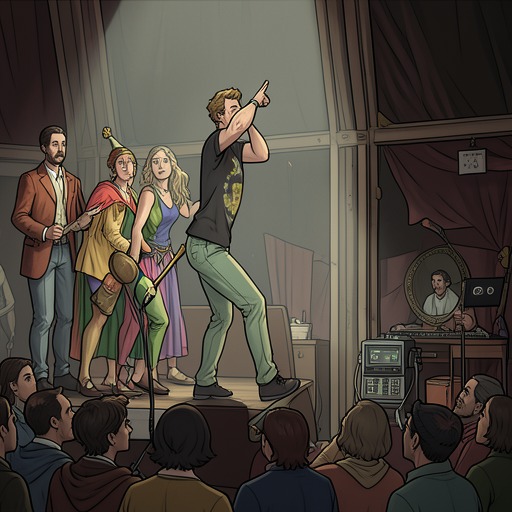
Gwynplaine’s public identity has been shaped by performance. His face provokes laughter whether or not he feels amused, and he has made a living exhibiting himself before audiences. The Green Box troupe gives that exposure a communal setting: Ursus devises performances, while Gwynplaine appears alongside him and the others. In the interlude Chaos Vanquished, for example, Gwynplaine plays a man struggling against forces represented by a wolf and a bear; the climactic illumination of his face turns the audience’s astonishment into contagious laughter. On the stage, his appearance is part of an arranged performance, and the crowd’s response brings the company success.
The camp’s disappearance reverses that arrangement. The audience is gone, the performance space has been stripped away, and Gwynplaine is left without the companions who gave his itinerant life its daily structure. The narrative does not establish in this scene where the troupe has gone or explain the specific decision behind the operation. It does, however, describe what happened to the fairground as an apparent police clearing, making the absence more than an ordinary pause between performances.
Discovery of the Empty Fairground
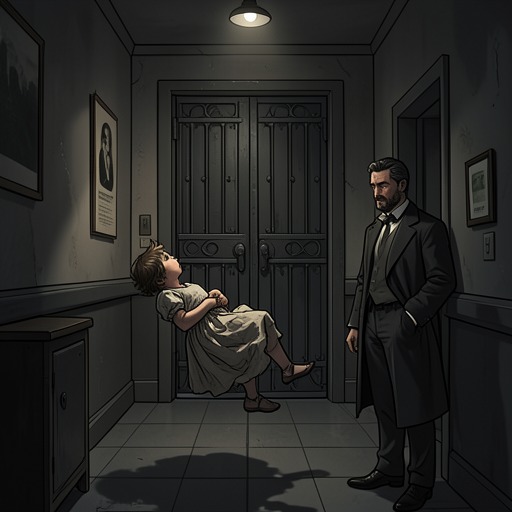
At night, Gwynplaine calls out for Ursus and Homo. The darkness does not conceal the central fact: the fairground is visible, but the familiar occupation of it has disappeared. No caravan remains; no tent, booth, or cart marks the troupe’s presence. The strollers whose noise and activity had filled the site have been replaced by an empty, silent space.
The discovery first reaches him through absence. He looks around and sees that everything has vanished; then anxiety drives him to test whether anyone might still be in the nearby house. He strikes at its door, gate, windows, shutters, and walls, trying one entrance after another. He calls for members of the company, including Ursus and Homo, and pauses to listen. No answer comes. His repeated calls and knocks cannot restore contact with the people who had made the place familiar.
Search and Signs of a Raid
Gwynplaine does not accept the first view as sufficient. He leaves the house and searches Tarrinzeau Field, going to the places where the tents and caravans had stood the day before. He knocks at the stalls despite knowing that they are unoccupied, and tests doors and windows throughout the deserted site. This methodical search establishes the extent of the change: there is no hidden pocket of the camp still in operation and no voice to explain its sudden absence.
The description of the fairground supplies the clearest indication of how the clearing occurred. The site appears to have been subjected to police measures, likened to a raid. It has not merely been vacated; it has been scoured and emptied, with the former encampment compared to an ant-hill that has been razed. The image makes the operation legible through its result: a crowded settlement has been reduced to bare space. Yet the scene gives no account of the officers, the precise procedure, or the troupe’s destination, so the evidence remains focused on what Gwynplaine finds rather than on the authorities’ motives.
Separation and Aftermath
After searching the fairground yard by yard, Gwynplaine leaves it and makes his way through the crooked streets toward the Thames. His movement marks the immediate consequence of the clearing: unable to find the troupe or obtain an explanation, he turns away from the place that had been its base. The search has found no people and produced no reply, only confirmation that the camp is gone.
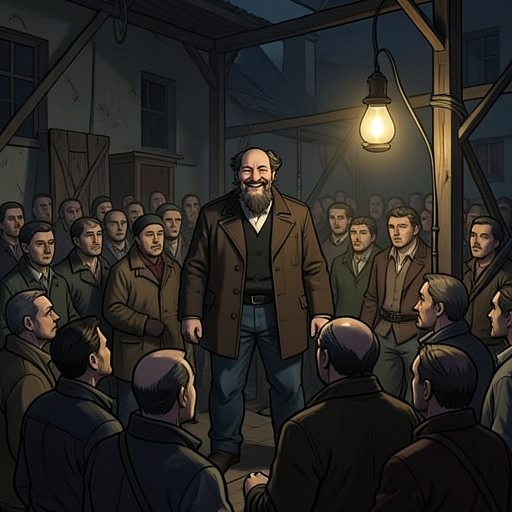
The episode’s force lies in its contrast with the public scenes surrounding Gwynplaine’s life. His performances can gather crowds around his fixed grin; in the House of Lords, his attempt to speak about the suffering of the poor is overtaken by the laughter of his listeners. At Tarrinzeau Field, there is no audience at all. The familiar stage, its performers, and the community around it have disappeared, leaving him alone to discover the consequences. The clearing is therefore both a material disruption of the troupe’s home and a personal separation whose cause and destination remain unresolved in the scene.